 Scanbrix

Go Back
Starbucks Is Spending $150M on Store Remodels
here's what every corporate architect, rollout program manager, and VP of Construction already knows, and what the press releases don't mention: the hardest part of a 1,000-store remodel isn't the design. It's getting accurate as-built documentation for 1,000 unique locations, each with its own quirks, modifications, and decades of undocumented changes.

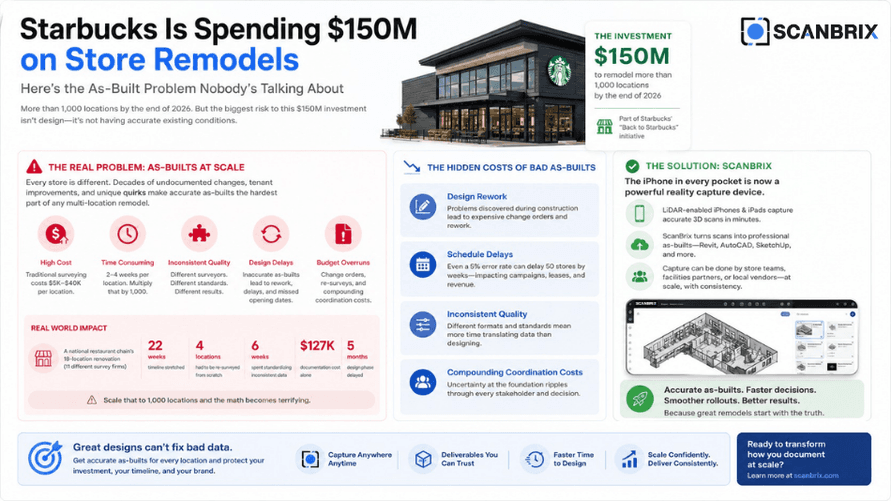
The biggest risk to a 1,000-location renovation program isn't design. It's not having accurate existing conditions for the stores you're about to redesign.
Starbucks is in the middle of the most ambitious physical transformation in its history. Under CEO Brian Niccol's "Back to Starbucks" initiative, the coffee giant is remodeling more than 1,000 locations by the end of 2026, a $150 million investment to bring back the cozy coffeehouse experience that made the brand iconic.
They're not alone. Jack in the Box announced plans to remodel nearly 1,500 locations. Wendy's launched "Project Fresh," a restructuring initiative that includes redesigning its highest-potential stores. Across fast food, fast casual, retail, and banking, major national brands are pouring billions into physical store transformations.
But here's what every corporate architect, rollout program manager, and VP of Construction already knows, and what the press releases don't mention: the hardest part of a 1,000-store remodel isn't the design. It's getting accurate as-built documentation for 1,000 unique locations, each with its own quirks, modifications, and decades of undocumented changes.
The Scale Problem That Breaks Traditional Surveying
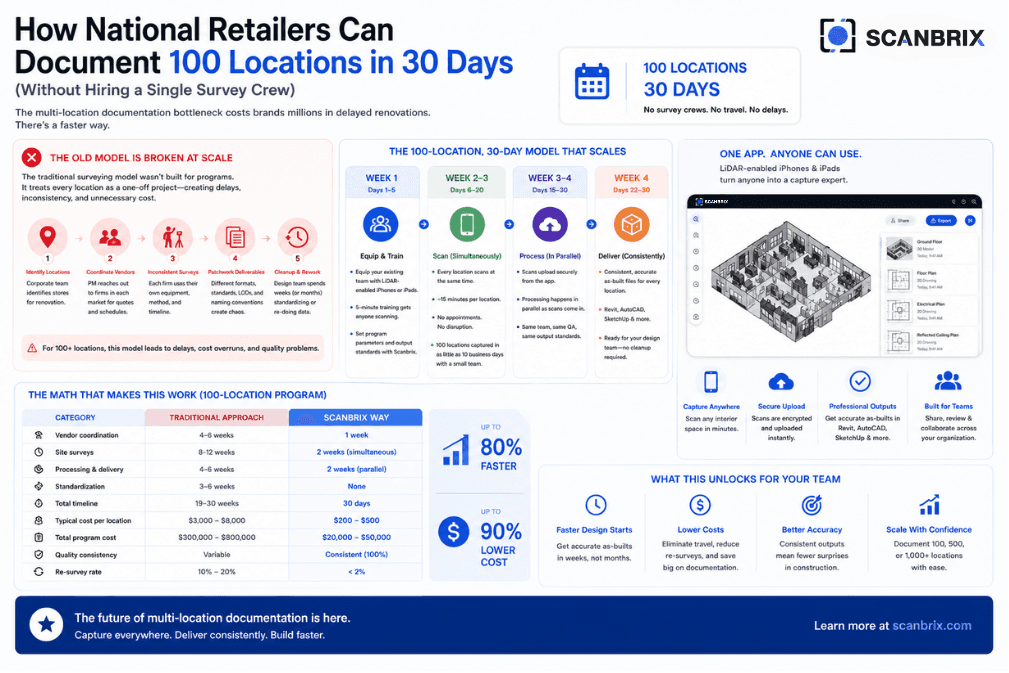
When you remodel a single location, documentation is straightforward. You hire a local surveyor or scanning firm. They show up with a terrestrial laser scanner, spend a day or two on site, and deliver a set of floor plans and elevations. Cost: $5,000–$40,000 depending on the building. Timeline: two to four weeks.
Now multiply that by 1,000 locations across dozens of markets.
This is where things fall apart. A recent case study published in Commercial Construction & Renovation Magazine illustrated the problem perfectly: a national restaurant chain planned an 18-location renovation across the Southwest and hired local surveyors independently in each market. Eleven different firms were involved. The result? Quality ranged from excellent at three locations to completely unusable at four. The timeline stretched to 22 weeks. Four locations had to be re-surveyed from scratch. The design team then spent six additional weeks just standardizing the inconsistent data formats before they could begin actual design work.
Total program cost for documentation alone: $127,000, and the entire design phase was delayed by nearly five months.
Scale that to 1,000 locations and the math becomes terrifying.
Why Every Store Is Different (Even When They're "The Same")
Corporate architects design prototype packages, standardized layouts, fixtures, and finishes that define the brand experience. In theory, every Starbucks or McDonald's or Verizon store follows the same playbook.
In reality, no two locations are identical. Strip mall end-caps have different column grids than freestanding buildings. A store that was built in 1998 has been through multiple tenant improvements, HVAC replacements, and counter reconfigurations that were never documented. The original construction drawings, if they even exist, reflect a building that no longer matches what's physically there.
This means every single location in a rollout program needs its own existing-conditions survey before the corporate prototype can be adapted to fit. Miss a load-bearing wall that was added during a previous renovation, and the new layout won't work. Get the ceiling heights wrong, and the new HVAC design fails. Overlook an electrical panel relocation, and you're looking at a change order that delays the opening by weeks.
For Starbucks, where the new designs emphasize expanded seating areas, redesigned espresso bars, and locally-inspired community touches, the existing layout of each café directly determines what's possible. You can't plan for "more generous lounge seating" if you don't know the exact dimensions and obstructions in each space.
The Real Cost of Bad As-Builts in Multi-Location Programs
The documentation problem creates a cascade of downstream costs that most program budgets don't adequately account for:
Design rework. When as-builts are inaccurate, architects discover the problems during construction, the most expensive possible time to find them. A wall that's six inches off from what the drawings show means the custom millwork doesn't fit, the plumber roughed-in to the wrong location, and the GC is submitting a change order.
Schedule delays. In a rollout program, every location has a target opening date tied to marketing campaigns, lease terms, and seasonal business cycles. One bad as-built can push a store opening back by weeks. Across a 1,000-location program, even a 5% error rate means 50 stores with significant delays.
Inconsistent quality. When you hire different surveyors in different markets, you get different levels of accuracy, different file formats, and different conventions. The design team spends as much time translating and standardizing documentation as they do designing.
Compounding coordination costs. Every stakeholder in the chain, corporate real estate, the architecture-of-record firm, local permit expeditors, general contractors, and store operations, is working from documentation that may or may not be reliable. Uncertainty at the foundation ripples through every decision.
The iPhone in Every Pocket
Here's what's changed: the device capable of capturing existing conditions for a renovation project is already in the hands of the people who know every store best, the employees who work there every day.
LiDAR-equipped iPhones and iPads can now capture 3D scans of interior spaces that serve as the foundation for professional CAD deliverables. Not rough sketches. Not "good enough" approximations. Actual as-built documentation in Revit, SketchUp, and AutoCAD formats that architects and designers can work from immediately.
For a national rollout program, this fundamentally changes the economics and logistics of documentation:
Speed. A store manager or regional facilities coordinator can scan a location in 15-20 minutes during off-peak hours. No need to schedule a survey crew, coordinate site access, or close the store for a day. Across 1,000 locations, this compresses the documentation timeline from months to weeks.
Consistency. When every scan goes through the same processing pipeline and gets delivered in the same CAD format by the same team, the quality variance problem disappears. Location #1 and location #1,000 arrive on the architect's desk in identical format and at consistent quality.
Cost. Traditional laser scanning for retail spaces runs $0.20-$0.70 per square foot with project minimums of $1,000 or more. For a typical 2,000-square-foot retail location, that's $2,000-$5,000 per store before you factor in travel, coordination, and project management overhead. iPhone-based scan-to-CAD services come in at a fraction of that cost, making it economically viable to document every location in a portfolio, not just the ones where the budget allows.
Zero logistics. No survey crews to dispatch. No travel expenses. No scheduling conflicts with store operations. The person scanning the space is already there, already knows the building, and can do it on their own schedule.
What This Means for Corporate Architects and Rollout Programs
If you're managing a multi-location renovation program, whether it's 50 stores or 5,000, the as-built documentation question is no longer "can we afford to scan every location?" It's "can we afford not to?"
The traditional model of hiring independent local surveyors in each market was designed for one-off projects. It was never built to handle the scale, speed, and consistency demands of a national rollout. The brands that figure this out first will move faster, spend less on rework, and open renovated locations on schedule.
The brands that don't will be the ones explaining to their board why a $150 million remodel program is running six months behind and 20% over budget, because the as-builts for 200 locations were wrong.
Scanbrix turns any LiDAR-enabled iPhone into a professional scanning tool that delivers production-ready Revit, SketchUp, and AutoCAD files within 1-2 business days. Whether you're managing 10 store renovations or 1,000, we make existing-conditions documentation fast, consistent, and affordable at any scale.