 Scanbrix

Go Back
How National Retailers Can Document 100 Locations in 30 Days
Scanbrix turns any LiDAR-enabled iPhone into a professional scanning tool that delivers production-ready Revit, SketchUp, and AutoCAD files within 1-2 business days. We've built our platform specifically for the kind of scale that multi-location programs demand — consistent quality, fast turnaround, and a workflow that any team member can execute.

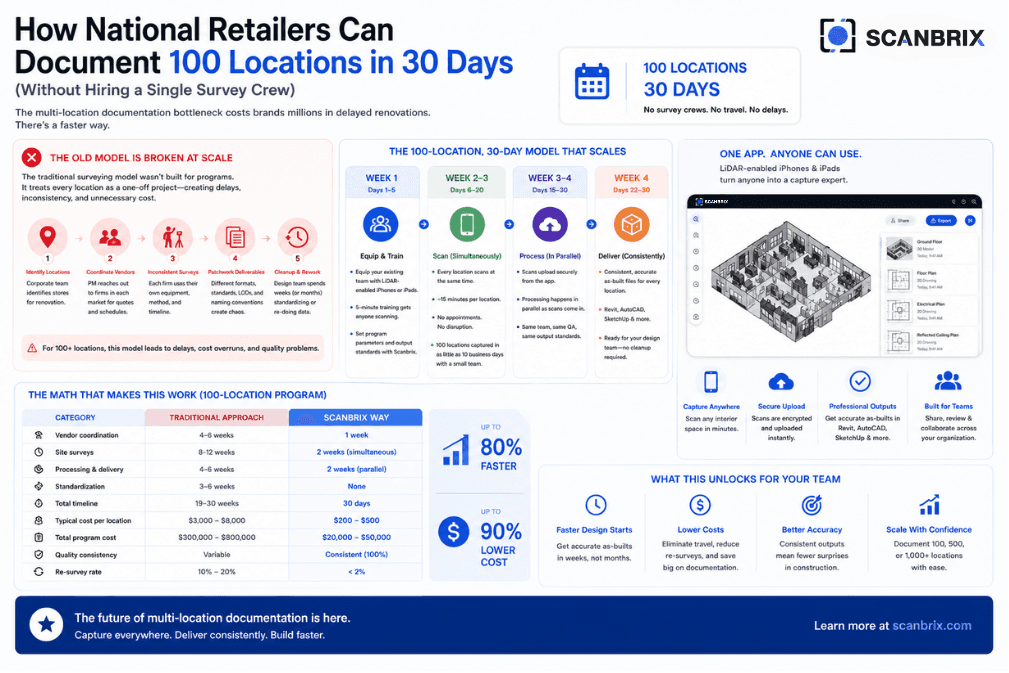
The multi-location documentation bottleneck costs brands millions in delayed renovations. There's a faster way.
Every national rollout program hits the same wall.
The design prototype is approved. The budget is allocated. The construction timeline is set. And then someone asks the question that grinds everything to a halt: "Do we have accurate as-builts for all the locations?"
The answer is almost always no. And what follows, a frantic scramble to coordinate survey crews across dozens of markets, is the single biggest source of delays, cost overruns, and quality problems in multi-site renovation programs.
But it doesn't have to be this way. The technology to document 100 (or 500, or 1,000) locations in 30 days already exists, and it doesn't require hiring a single traditional survey crew.
The Old Model Is Broken at Scale
Here's how most national brands currently handle as-built documentation for rollout programs:
Step 1: The corporate construction team identifies the locations slated for renovation.
Step 2: A project manager reaches out to surveying or scanning firms in each market to get quotes and schedule site visits.
Step 3: Each local firm shows up on their own timeline, uses their own equipment and methodology, and delivers documentation in their preferred format.
Step 4: The architecture-of-record firm receives a patchwork of drawings — some in Revit, some in AutoCAD, some as PDFs, some as raw point clouds with no modeling. Quality, naming conventions, levels of detail, and coordinate systems vary wildly.
Step 5: The design team spends weeks (sometimes months) cleaning up, standardizing, and in some cases re-doing the documentation before they can begin adapting the prototype design to each location.
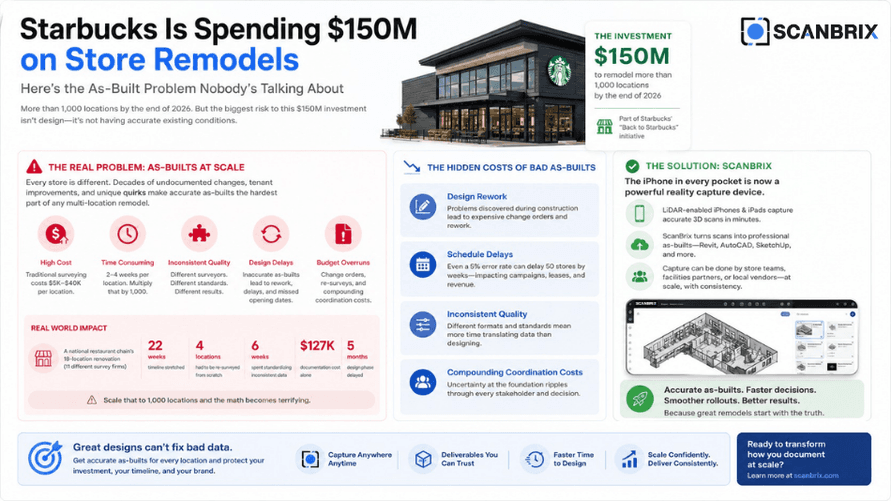
For a 10-location program, this process is merely frustrating. For 100 locations, it's a logistical nightmare. For 1,000 locations, the scale at which brands like Starbucks, McDonald's, and major retail chains operate, it's fundamentally unworkable.
The root cause is simple: the traditional surveying model was designed for individual projects, not programs. It treats every location as a standalone engagement with its own vendor, its own timeline, and its own quality standard. When you need consistency across hundreds of locations, that model breaks.
What "100 Locations in 30 Days" Actually Looks Like
The alternative starts with a simple insight: the most expensive parts of traditional surveying — travel, equipment, and specialist labor — are also the parts that don't scale.
Here's the model that does scale:
Week 1: Equip and Train (Days 1–5)
Instead of dispatching survey crews to every market, you equip the people who are already at every location: store managers, district managers, regional facilities coordinators, or any team member with a LiDAR-enabled iPhone or iPad.
The training is minimal. Modern scan-to-CAD apps are designed for non-technical users. A 5-minute video walkthrough covers scanning technique, what to capture, and how to upload. Most people are comfortable after scanning one or two practice rooms.
During this first week, you also establish the program parameters with your scan-to-CAD provider: output format (Revit, SketchUp, AutoCAD), level of detail needed, naming conventions, and delivery schedule. Scanbrix can even customize outputs to match your standards.
Week 2–3: Scan (Days 6–20)
Here's where the model fundamentally diverges from traditional surveying. Instead of scheduling sequential site visits across every market, every location scans simultaneously.
A store manager in Phoenix scans their location on Monday morning before the lunch rush. A district manager in Atlanta scans three locations on Tuesday. A facilities coordinator in Chicago knocks out five stores over the course of the week.
Each scan takes ~15 minutes for a standard retail location, depending on the size of the space. No appointments to schedule. No site access to coordinate. No disruption to store operations. The person scanning already has keys, already knows the building, and can work around the business schedule.
At this pace, 100 locations can be captured in two weeks with a relatively small number of people doing the scanning. Even if each scanner only does one or two locations per day, a team of 10 people spread across the country covers 100 stores in 10 business days.
Week 3–4: Process and Deliver (Days 15–30)
As scans come in, the scan-to-CAD processing team works in parallel, not sequentially. There's no waiting for all 100 scans to arrive before processing begins. The first scans submitted are the first ones delivered.
Because every scan goes through the same pipeline, same team, same QA standards, same output format, the deliverables are consistent from location #1 to location #100. The architecture-of-record firm receives a uniform set of Revit or AutoCAD files, all at the same level of detail, all using the same conventions.
No standardization phase. No format conversion. No re-surveying locations where the local vendor produced unusable work.
The Math That Makes This Work
Let's compare the two approaches for a 100-location program of 2,000-square-foot retail spaces:
Traditional Approach
Vendor coordination: 4–6 weeks to identify, quote, and schedule local firms in each market
Site surveys: 8–12 weeks for all 100 locations (limited by crew availability and travel logistics)
Processing and delivery: 4–6 weeks for individual firms to deliver
Standardization: 3–6 weeks for the design team to normalize inconsistent deliverables
Total timeline: 19–30 weeks
Typical cost per location: $3,000–$8,000 (scanning + travel + processing)
Total program cost: $300,000–$800,000
Quality consistency: Variable — depends on which local vendor handled each market
Re-survey rate: 10–20% of locations typically need partial or complete re-documentation
iPhone Scan-to-CAD Approach
Training and setup: 1 week
Scanning (all locations in parallel): 2 weeks
Processing and delivery (overlapping with scanning): 2 weeks
Total timeline: 4–5 weeks
Cost per location: Dramatically lower than traditional scanning
Total program cost: A fraction of the traditional approach
Quality consistency: Uniform — every scan processed by the same team
Re-survey rate: Near zero — if a scan needs improvement, the store manager re-scans in 20 minutes
The time savings alone are significant. Getting as-built documentation 15–25 weeks faster means the design phase starts sooner, construction starts sooner, and renovated locations open sooner. For a restaurant or retail location generating $5,000–$50,000 per day in revenue, every week a renovation is delayed has a real dollar cost.
Who Does the Scanning? (It's Easier Than You Think)
The most common objection we hear from corporate construction teams is: "Our store managers aren't surveyors. How do we trust them to capture accurate data?"
It's a fair question, and the answer lies in understanding what the scan actually needs to capture versus what the processing team handles.
The person with the iPhone is responsible for one thing: walking through the space and capturing complete coverage. That means pointing the phone at every wall, ceiling, corner, and fixture so the LiDAR sensor can map the geometry. It's similar to taking a video. If you can record a video of a room, you can scan it.
Everything else, converting that 3D data into dimensioned floor plans, elevations, and CAD models, happens downstream. Professional CAD operators process the scan data, verify measurements, and produce the deliverables that architects actually work from. The store manager doesn't need to know what a Revit family is or how to draw a section cut. They just need to walk through the building with their phone.
This division of labor is what makes the model work at scale. You're leveraging the one thing that a person on-site can do better than anyone else (physically being there) while keeping the technical work centralized where quality can be controlled.
Industries Where This Model Has the Biggest Impact
Quick-Service and Fast-Casual Restaurants
Brands running hundreds or thousands of locations through remodel programs, new kitchen layouts, updated dining areas, drive-thru modifications, digital menu board installations. Every location needs existing-conditions documentation, and the renovations typically happen while the store stays open, making minimally disruptive scanning critical.
Retail Chains
From apparel to electronics to home improvement, retail brands regularly refresh store layouts, update fixtures, and renovate to match new brand standards. The challenge is compounded by the variety of real estate formats, mall in-lines, strip mall end-caps, freestanding buildings, each with different structural constraints.
Banking and Financial Services
Branch transformation programs are moving banks from transaction-focused layouts to advisory-focused experiences. Thousands of branches nationwide need documentation before architects can redesign teller lines into consultation pods, remove bullet-resistant barriers, and create open floor plans.
Telecom and Wireless
Carriers like Verizon, AT&T, and T-Mobile regularly refresh their retail stores to showcase new devices and service models. The stores are typically small (1,000–2,500 sq ft) but numerous, making them ideal candidates for high-volume, low-cost scanning.
Healthcare and Urgent Care
Chains expanding or renovating clinic spaces, from CVS MinuteClinics to urgent care networks, need as-built documentation that accounts for exam room layouts, ADA compliance, and MEP systems specific to healthcare occupancy.
Fitness and Wellness
Gym and studio chains rolling out new equipment layouts, locker room renovations, or brand refreshes across regional or national footprints.
Getting Started: What a Pilot Program Looks Like
You don't have to commit to 1,000 locations on day one. The most effective way to prove this model works for your organization is a focused pilot:
Pick 5–10 locations across 2–3 markets that represent your typical building types (freestanding, strip mall, mall in-line, etc.).
Identify your scanners. District managers or facilities coordinators are usually the best fit, they're already visiting stores regularly and understand the physical spaces.
Define your deliverables. What does your design team need? Revit models? AutoCAD floor plans? SketchUp files? Specify the output format and level of detail upfront so you can evaluate the results against your actual workflow.
Compare the results against your current documentation process, on cost, speed, accuracy, and usability. Most teams that run a pilot never go back to the old model.
The Bottom Line
The multi-location documentation problem isn't a technology problem. The technology already exists in the phones your team carries every day. It's a process problem, and the brands that solve it first will have a measurable competitive advantage in how fast they can execute renovation programs.
When your competitor is still waiting for survey crews to finish documenting their 50th location, you'll be starting construction on your 100th.
Scanbrix turns any LiDAR-enabled iPhone into a professional scanning tool that delivers production-ready Revit, SketchUp, and AutoCAD files within 1-2 business days. We've built our platform specifically for the kind of scale that multi-location programs demand — consistent quality, fast turnaround, and a workflow that any team member can execute.
Start a free scan today | Book a demo for your rollout program