 Scanbrix

Go Back
The Modern Existing Conditions Workflow for Architects (From Site Visit to CD Set)
“Existing conditions” is one of the most commonly referenced, and least consistently executed, phases in architectural practice. Nearly every renovation or adaptive reuse project depends on it. Yet when issues surface later in CDs or construction, they’re often traced back to early assumptions made during existing conditions documentation. This isn’t because architects don’t care about accuracy. It’s because existing conditions are frequently treated as a task rather than a workflow. This article outlines what a modern existing conditions workflow looks like today, how it differs from traditional approaches, and how architects can create documentation that meaningfully supports design development and construction—without slowing projects down.

“Existing conditions” is one of the most commonly referenced, and least consistently executed, phases in architectural practice.
Nearly every renovation or adaptive reuse project depends on it. Yet when issues surface later in CDs or construction, they’re often traced back to early assumptions made during existing conditions documentation.
This isn’t because architects don’t care about accuracy. It’s because existing conditions are frequently treated as a task rather than a workflow.
This article outlines what a modern existing conditions workflow looks like today, how it differs from traditional approaches, and how architects can create documentation that meaningfully supports design development and construction—without slowing projects down.
What “Existing Conditions” Actually Means in Architecture
In practice, “existing conditions” sit in a gray area.
It is often confused with:
As-built drawings
Surveys
Permit sets
Contractor records
In reality, existing conditions documentation is architect-produced information intended to support design decisions. It represents the architect’s best understanding of the current state of a building, based on observation, measurement, and professional judgment.
Existing conditions are:
Selective, not exhaustive
Purpose-driven, not archival
Integrated into the design process
They are not a guarantee of construction accuracy, but they are a foundation for responsible design.
Why Existing Conditions Are the Most Underestimated Phase of a Project
Most downstream problems don’t originate in design development or construction documents. They originate earlier, when assumptions quietly replace verified information.
Examples are familiar:
Ceiling heights assumed to be consistent
Floor elevations simplified
Structural elements generalized
Wall thicknesses standardized without verification
Once these assumptions enter drawings, they tend to persist. By the time conflicts appear, they’re harder, and more expensive, to resolve.
Existing conditions are underestimated because:
They’re compressed under tight schedules
They’re viewed as overhead rather than value
Their impact isn’t immediately visible
But they quietly influence everything that follows.
What Architects Are Actually Responsible For (And What They’re Not)
Architects are not surveyors, and existing conditions drawings are not certified surveys.
That distinction matters.
Architects are responsible for:
Exercising professional judgment
Clearly documenting observed conditions
Identifying constraints that affect design
Communicating uncertainty where it exists
Architects are not responsible for:
Verifying property boundaries
Certifying elevations or legal dimensions
Discovering concealed conditions without investigation
A modern workflow doesn’t eliminate uncertainty, it documents it clearly.
Explicit notes such as “to be verified,” “assumed,” or “based on limited access” are not weaknesses. They are professional safeguards.
The Traditional Existing Conditions Process (And Why It Breaks Down)
The traditional approach is familiar:
A site walk
Selective measurements
Photos taken on a phone
Notes captured in a sketchbook
Drawings produced days or weeks later
This process relies heavily on memory and interpretation. Over time:
Context is lost
Photos lack dimensional meaning
Notes are re-interpreted by different team members
Gaps go unnoticed until design is underway
The issue isn’t effort, it’s fragmentation of information.
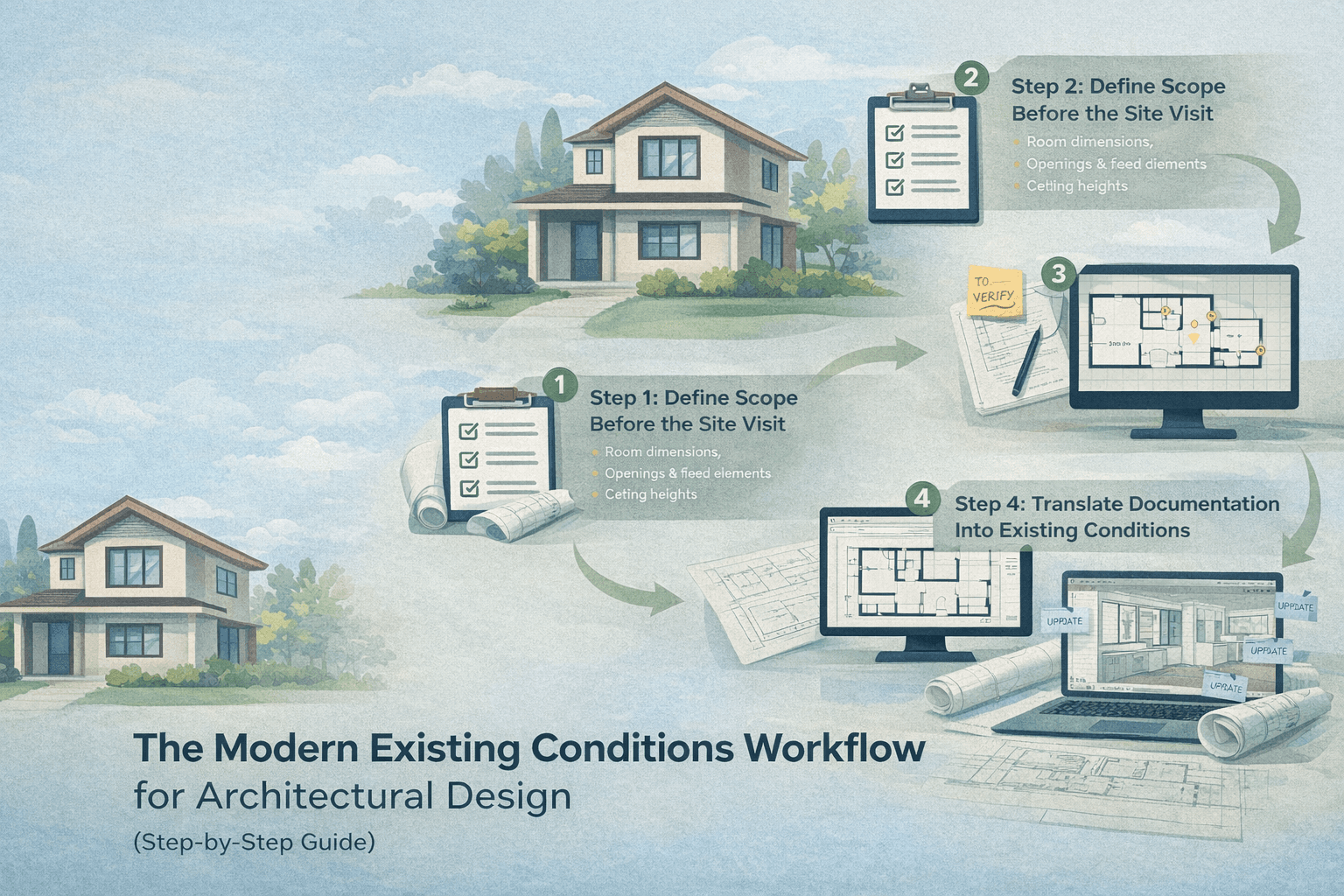
The Modern Existing Conditions Workflow (Step by Step)
A modern workflow treats existing conditions as a continuous system, not a one-time visit.
Step 1: Define Scope Before the Site Visit
Before stepping on site, teams should be aligned on:
Which spaces require dimensional accuracy
Which conditions affect design risk
Which elements can remain qualitative
This avoids both under-documentation and unnecessary effort.
Step 2: Capture Spatial Relationships, Not Just Dimensions
Existing conditions are about relationships:
How spaces connect
Where ceilings change
Where structure interrupts volume
How floors step or slope
Capturing these relationships reduces reliance on assumptions later. Many firms now focus on documenting transitions and constraints rather than isolated room measurements.
Step 3: Verify and Flag Unknowns Early
A critical, but often skipped, step is review.
Before documentation moves into drawings:
Gaps are identified
Inconsistencies are flagged
Unknowns are explicitly noted
This step prevents incomplete information from silently becoming design intent.
Step 4: Translate Documentation Into Existing Conditions Drawings
Good existing conditions drawings prioritize:
Clarity over density
Legibility over exhaustiveness
Usefulness over completeness
They are drawn to be referenced repeatedly throughout the project, not archived and forgotten.
Step 5: Carry Existing Conditions Through CDs
One of the most common failures is allowing existing conditions information to degrade as projects progress.
A modern workflow ensures that:
Existing conditions assumptions are tracked using software like AutoCAD or Revit
Updates are reflected consistently
Conflicts are resolved deliberately, not accidentally
Common Existing Conditions Failures That Show Up in Construction Documents
When existing conditions fall short, issues often surface as:
Inconsistent ceiling heights between plans and sections
Structural conflicts during coordination
Door and opening discrepancies
Misaligned floor elevations
Each of these traces back to an early documentation gap.
Manual vs Digital Existing Conditions Documentation (Without the Tool Debate)
The question isn’t analog versus digital—it’s process quality.
Key criteria include:
Accuracy appropriate to scope
Reusability across phases
Accountability and clarity
Ease of team handoff
Many firms combine methods. What matters is whether the documentation supports confident decision-making later.
What a “Good” Existing Conditions Set Should Include
At a minimum:
Floor plans with clear dimensions
Key sections showing vertical relationships
Ceiling conditions and changes
Fixed elements and constraints
Notes on irregularities and assumptions
A good set of Existing Conditions answers questions instead of creating them.
How Better Existing Conditions Reduce RFIs, Redlines, and Liability
Strong existing conditions documentation leads to:
Fewer RFIs during construction
Cleaner coordination sets
Reduced redesign late in the process
Stronger professional positioning
The upfront investment pays dividends across the project lifecycle.
Final Thought: Existing Conditions Are an Architectural System
Existing conditions are not a formality or a checkbox. They are an architectural system that supports everything from concept design to construction coordination.
When treated with intention and rigor, they don’t slow projects down—they make them move faster, with fewer surprises and stronger outcomes.